Landmark victory for Kenyan peasants and seed sovereignty
Editor’s note: A new court ruling marks a historic milestone for peasants’ rights and the right to seeds in Kenya and internationally. In an unprecedented decision, the High Court has reaffirmed that rights protected by the Constitution must be interpreted in light of international frameworks such as the United Nations Declaration on the Rights of Peasants and Other People Working in Rural Areas (UNDROP), which in Article 19 explicitly recognises the right to save, exchange, use and sell one’s own seeds as an essential part of peasant autonomy and sustainable food systems. This ruling not only redefines the scope of national seed legislation, but also consolidates UNDROP as a legal reference in the protection of traditional knowledge, agricultural biodiversity and food sovereignty. This sets a new precedent that strengthens the enforceability of peasant rights.
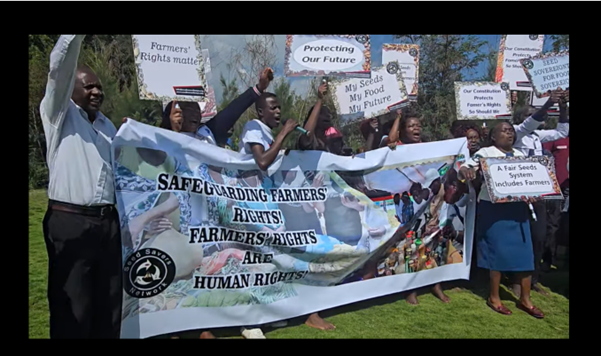
On November 27, 2025, the High Court of Kenya in Machakos delivered a much-awaited decision in a constitutional challenge to the Seeds and Plant Varieties Act mounted by smallholder farmers. The Court decided in favour of the petitioners on all counts, striking down various sections of the Act and Regulations.
As reported earlier on Defending Peasants’ Rights, the constitutional challenge to the Seeds and Plant VarietiesAct was filed in 2022 by a group of peasants of Seeds Savers Network against the government agency responsible for implementing the Act.
Revised in 2012, Kenya’s Seeds and Plant Varieties Act is a draconian law that prohibits peasants from saving, sharing, exchanging and selling seeds under penalty of criminal sanctions. In her decision, the judge declared that various provisions of the Act were contrary to the Constitution of Kenya, the FAO Plant Treaty and the United Nations Declaration on the Rights of Peasants and Other People Working in Rural Areas (UNDROP). The judge ruled that the Constitution had to be read along with Article 9 of the Plant Treaty and article 19 of UNDROP, and that Kenya was bound by its obligations under international law in general and international human rights in particular.
More specifically, the judge struck down the section of the Act that gives inspectors who reasonably believe that a breach has been committed the power to seize and dispose of seeds. The judge ruled that this violates a peasant’s right to the privacy of their person, home and property, as enshrined in the Constitution. The Judge also noted that failure to define “reasonable belief” and to provide for an independent oversight mechanism could lead to arbitrariness and abuse.
Importantly, the judge declared that several provisions of the Act are unconstitutional because they infringe on peasants’ right to save, use, share, exchange and sell farm-saved seeds. These provisions criminalize the sale of seeds unless they are certified seeds sold by registered merchants, and limit peasants’ rights over their harvest grown from protected varieties.
The judge ruled that by restricting the right to save, share and exchange seeds, these provisions are contrary to the Constitution, which affirms that the State must recognize the role of science and Indigenous technologies, and recognize and protect the ownership of indigenous seeds and plant varieties, their diverse characteristics and their use by the communities of Kenya. Given the important contribution of smallholder farmers to food production, the Judge determined that these provisions also violate the right to food guaranteed by the Constitution, and Kenya’s obligation to take legislative, policy and other measures to achieve its progressive realization. Finally, the Judge also ruled that exorbitant registration fees, coupled with strict registration requirements, amount to indirect discrimination against smallholder farmers and peasants.
Regarding the right to participation, the Judge observed that many of the issues raised in the petition could have been avoided had the government ensured the right to adequate and meaningful participation by peasants, interested parties and the public in the process of developing the legislation. The Judge directed the government to ensure the right to participation in the process of amending the law to comply with the judgment.
It is not yet known if the Kenyan government will appeal the decision. In any case, this judgment is a game changer for millions of Kenyan peasants and sets a powerful precedent for peasants’ rights and the right to seeds globally.
***
Judgment of the High Court of Kenya, available here:
https://new.kenyalaw.org/akn/ke/judgment/kehc/2025/18166/eng@2025-11-27
Constitution of Kenya (in particular, arts. 11, 21(2) and 43(1):
https://kenyalaw.org/kl/fileadmin/pdfdownloads/TheConstitutionOfKenya.pdf
Kenya’s Seeds and Plant Varieties Act:
https://upovlex.upov.int/en/legislation/text/506145