Burkina Faso: The peasantry, a seed of change?
Article by Raffaele Morgantini, representative of CETIM at the UN, published in French in Le Courrier, Monday 15 December 2025.
Since taking power through a coup d’état in September 2022, Captain Ibrahim Traoré has assumed the presidency of Burkina Faso, leaving no one indifferent: for some, he embodies a historic turning point marking a break with the neo-colonial order and the beginning of a popular pan-African revolution; for others, it is yet another despotic show of force orchestrated by a military regime. This article seeks to provide an original perspective, in light of the balance of power at play, by giving a voice to Burkinabè social movements – peasants in particular.
Burkina Faso has for years faced a situation of war, mainly in the north, under jihadist threat, and since 2022 has been subjected to increased international pressure, manifested through sanctions regimes imposed by France, the World Bank, the European Union and the Economic Community of West African States (ECOWAS). Heir to a long colonial past and illegitimate debt, the Traoré government seeks to restore national sovereignty and to position itself within a new pan-African dynamic.
Together with its partners in the Alliance of Sahel States – Mali and Niger – the country is challenging the CFA franc and considering an independent or common currency, while progressively disengaging from the IMF, the World Bank and the BCEAO (Central Bank of West African States). The refusal of new Western loans signals a desire to break free from financial dependency.
On the economic front, Burkina Faso has embarked on a process of nationalising strategic sectors. In 2023, the state regained control of major gold mines. A new mining code adopted in 2024 strengthens sovereignty over resources, increases the state’s share in mining companies, imposes local processing and creates a strategic gold reserve. In 2025, a mining residue treatment centre was inaugurated.
Economic reconquest also encompasses the agri-food sector, through nationalisations and the industrialisation of factories in sugar production, dairy processing and tomato production/processing, a key sector for the country. Despite a conflict-ridden regional context, these choices constitute essential levers for establishing real sovereignty and strengthening the state’s capacity to finance social policies.
Giving a voice to peasants
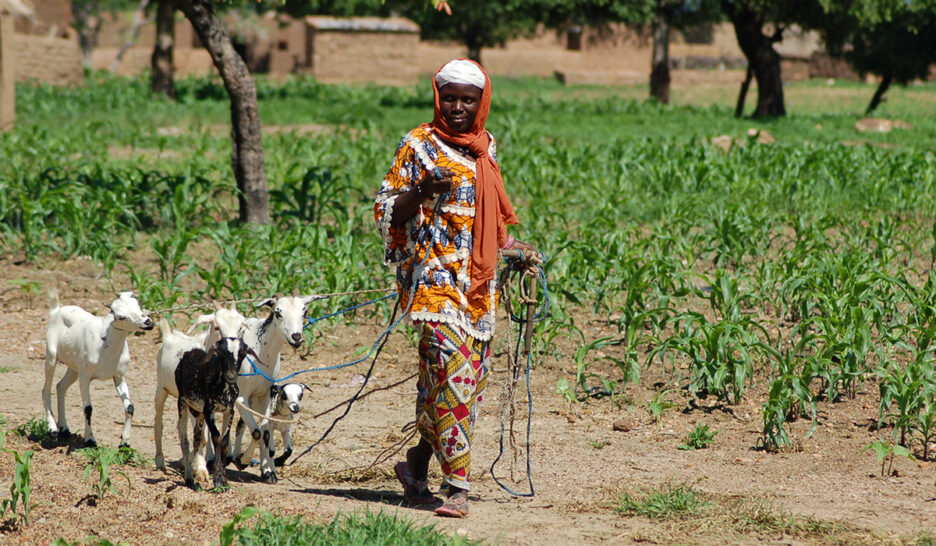
In Burkina Faso, 80% of the active population works in agriculture (around 32% of national GDP), and nearly 90% of farms are family holdings of less than five hectares, illustrating the predominance of subsistence agriculture. This shows how central small-scale food producers – peasants, nomads, herders and artisanal fishing communities – are to society.
It is in this light that the government launched its “Agropastoral and Fisheries Offensive 2023–2025”, with the objective of achieving self-sufficiency and food sovereignty. Within this framework, numerous investments have been made: agricultural equipment, local processing infrastructure, and support for cereal, rice and horticultural sectors. The results are tangible: tomato, rice and maize production increased considerably between 2022 and 2024, and since then rural exodus has declined1.
Beyond the figures, it is the commitment of rural communities that stands out. Long marginalised, they now form the core of the new societal project, recognised as political agents of change. Two grassroots leaders, Mr Alassane Nakande (a key figure in the West African Convergence of Struggles for Land and Water2 and executive director of the African Movement for Environmental Rights) and Ms Ouédraogo Ouandegma (president of the Burkinabè Coordination of Peasant Organisations, member of La Via Campesina and of the Agropastoral Workers’ Union) testify to the profound changes under way. These changes, particularly the progress achieved, help promote a peasant agenda consistent with the provisions and principles of the UN Declaration on the Rights of Peasants and Other People Working in Rural Areas (UNDROP), which recognises fundamental rights such as the right to land and the right to seeds.
Strengthening local peasant production
For Ms Ouandegma, the initiative to protect and promote local production “is positive, in that it concretely supports peasant organisations in consolidating their means of production, supply chains, peasant cooperatives and local markets”. The peasant representative points to “government efforts” which have “enabled access to tools and materials for agricultural production and processing (rice processing units, tractors…)”. Thanks to this initiative, “it is small producers and local peasant cooperatives that directly supply their products to hospitals, municipalities, school canteens, prisons… This has made it possible to implement short supply chains, open markets to the smallest producers, and promote local products”.
Land policy and the right to land
Historically, Burkina Faso has faced large waves of land grabbing by private and financial operators who have benefited from a vague and permissive legal framework. In response, Mr Nakande notes that “thanks to the authorities’ willingness to tackle this phenomenon through the revision of pro-land-grabbing laws, a better redistribution of land is becoming possible”. The peasant leader adds that these legislative changes are “accompanied by support measures, notably in the form of installation kits for young peasants”. The process is part of “a broader logic of strengthening food security and sovereignty”, with other ongoing initiatives – action research, feasibility studies, concrete measures – aimed at “enhancing the role of agricultural producers and restoring their central place in public policies”.
For her part, Ms Ouandegma states that the authorities’ land policy “helps strengthen security and legal recognition of land tenure rights for women and men peasants”. She also welcomes the government’s commitment to allocate at least 30% of land titles to women producers.
Agroecological policies
In the field of agroecology – a key concept and set of practices promoted by the international peasant movement – Mr Nakande notes that “within the National Assembly and the Senate, a joint commission has been created to address the challenges surrounding the promotion of agroecology. In the same vein, a law has been adopted promoting the use of biological inputs”.
In its national strategy (SND-AE 2023–2027), the Burkinabè government supports the intensification of agroecological practices, in collaboration with peasant organisations, in order to sustainably ensure food and nutritional security in a context marked by climate crises – declining rainfall, soil and water resource degradation, loss of biodiversity, droughts, floods, etc.
Another major agroecological initiative concerns the demand, expressed by rural actors, for the gradual abandonment of chemical pesticides. To this end, new spaces for negotiation and advocacy have been opened. Ms Ouandegma notes a “shared willingness, both on the part of the rural movement and the authorities, to resolutely steer the country towards a tangible agroecological transition”.
Protection of peasant seeds
Regarding phytogenetic resources and the protection of peasant seeds, Mr Nakande observes positive developments. First, with the “creation of a Commission dedicated to phytogenetic resources, which provides a political framework enabling work in favour of peasant proposals”. Secondly, with the adoption of a new agropastoral law recognising the status of farmer/peasant and strengthening the protection of the right to seeds. “This law lays the foundations for a favourable framework for seed conservation, notably through the establishment of a dedicated database”. For the peasant representative, this represents a real qualitative leap: “From now on, each peasant will be able to actively participate in preserving the local food system and maintaining biodiversity”.
A dialectic at work
It is clear that the peasant world must constitute a political force at the heart of Burkina’s process of social, economic and political transformation. This transformation will either take place with their involvement, or it will not take place at all. But it should be recalled that any process of political transformation is inevitably accompanied by dialectical trajectories, marked by internal tensions and constant contradictions. All the more so in a country like Burkina Faso. Yet the vast majority of external analyses tend to ignore this complexity of power relations, in favour of Manichean and decontextualised judgements, often Eurocentric.
Nevertheless, this does not mean that one should turn a blind eye to the regime’s authoritarian excesses, which must be named: arrests of journalists, repression against anti-imperialist social movements such as Balai citoyen or other social organisations, bans on political parties, and the extension of military rule. While war and external pressures may explain certain decisions, they do not justify violations of the population’s fundamental rights.
Any transformative political process that claims to be progressive requires democratic debate. Internal as well as external criticisms – if constructive and free from any imperialist logic – can and must help steer this process towards genuine popular emancipation, and correct its course where necessary. What is happening in Burkina Faso is an unprecedented attempt at pan-African renewal, centred on a self-reliant and self-determined development model – a turning point on a continent that continues to endure the neo-colonial yoke. In this context, the Traoré government enjoys considerable popular support, particularly from social movements in rural areas and from the youth, who reject neo-colonial fatalism and demand national and popular sovereignty.
This is not about idealising. But, in a world still structured by deep neo-colonial relations of domination, any attempt at national liberation deserves to be examined and supported, especially if it is driven by the popular classes and grassroots social movements. In such processes, the only meaningful safeguard against setbacks is a didactic dialogue between popular forces and the government. The ongoing challenge for CETIM is therefore to remain a platform for popular sovereignty, rooted in the support of the popular masses, and not isolated from them.
- «How Burkina Faso wants to achieve food sovereignty», Africa’s New Directions, Al Jazeera, www.youtube.com/watch?v=Gr4qjvShT0U&t=106s ↩︎
- La Convergence globale des luttes pour la terre et l’eau en Afrique de l’Ouest est un mouvement social de paysan·nes et autres travailleur·euses des zones rurales. Créé à la suite du Forum social africain de Dakar en 2014, le réseau est composé de 15 plateformes nationales. A l’échelle sous-régionale, l’initiative vise à promouvoir des systèmes alimentaires plus équitables et démocratiques et défend l’accès légitime aux ressources naturelles (terre et eau), ainsi que les droits humains qui en découlent. ↩︎