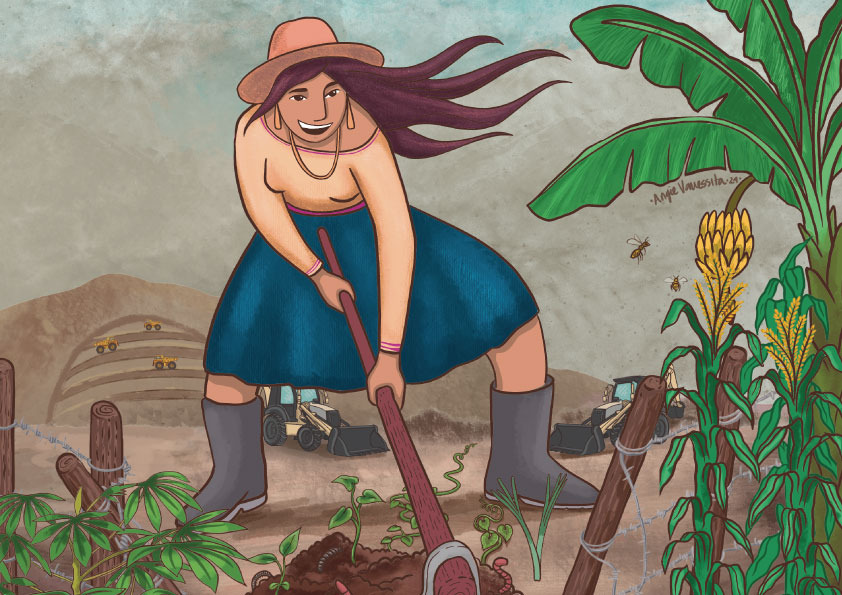
Rural Women as Rights Holders: UNDROP from the Perspective of Those Who Safeguard Life
This publication, originally produced by the Network of Rural Women of Ecuador and FIAN Ecuador, is hereby republished by Defending Peasant Rights.
The Network of Rural Women of Ecuador has set out to analyze the realities affecting life in their territories in light of the United Nations Declaration on the Rights of Peasants and Other People Working in Rural Areas (UNDROP). This declaration constitutes a substantive tool for rural women, as it guarantees fundamental rights that enable adequate conditions to sustain a dignified life in the territories where they care for and nurture life. Having this instrument is particularly essential in the current adverse context the country is facing.
The paid and unpaid work that rural women perform creates the necessary conditions for human life, nature, and organizational capacity to continue reproducing. Consequently, when they fully exercise the rights recognized in UNDROP and in the Constitution of the Republic of Ecuador (CRE), and have the dignity conditions required, that dignity is also extended to the spaces in which they operate daily. Rural women are pathbreakers; through their work “plowing the land,” in multiple ways, they make it possible for life to persist and continue flourishing in their environments, even amid structural and situational adversities. For this reason, it is imperative that they be recognized as subjects of special protection: rural women must be fully recognized as rights holders.
This report was prepared by the Network of Rural Women of Ecuador through a collective and participatory process, with the aim of making visible and denouncing the violations they face. It is an exercise in naming, denouncing, and amplifying commonly silenced violences, as well as creating spaces for strengthening, reflection, and organizational unity. Based on their voices, knowledge, and experiences, rural women prioritized the analysis of four rights enshrined in UNDROP that are severely affected and compromise their capacity for subsistence: 1) land and territory; 2) adequate food and nutrition; 3) non-discrimination; and 4) environment and water.
The document is structured in four sections: first, a brief contextual analysis; second, an argument regarding the binding nature of UNDROP within the framework of the CRE; third, an examination of the four prioritized rights, including a contextualization of their situation and an analysis of the applicable legal framework in UNDROP and the CRE; and finally, a set of recommendations directed to the Ecuadorian State.
Organizations from the Network of Rural Women of Ecuador participated in the preparation of this report, with the support of FIAN Ecuador in facilitating and systematizing the process.
Full report (Spanish only):