The outcomes of the ICARRD+20 from the perspective of rural and indigenous movements
Following the conclusion of the ICARRD+20 conference, held in Cartagena (Colombia) from 24 to 28 February, social movements have expressed their rejection of the conference’s final declaration, while praising their unity in the common struggle for rural and Indigenous people’s rights.
This publication contains a press release originally published by La Via Campesina on 28 February 2026, as well as a video of a collaborative interview with representatives of social movements livestreamed by CLOC/LVC on 5 March 2026, discussing the conclusions of ICARRD+20 and the Forum of Peoples and Social Movements.
Indigenous Peoples And Social Movements Reaffirm Unity And Support To ICARRD+20 Organisers, But Reject Conference Declaration
By La Via Campesina (28 February 2026)
PRESS RELEASE | CARTAGENA DE INDIAS, COLOMBIA
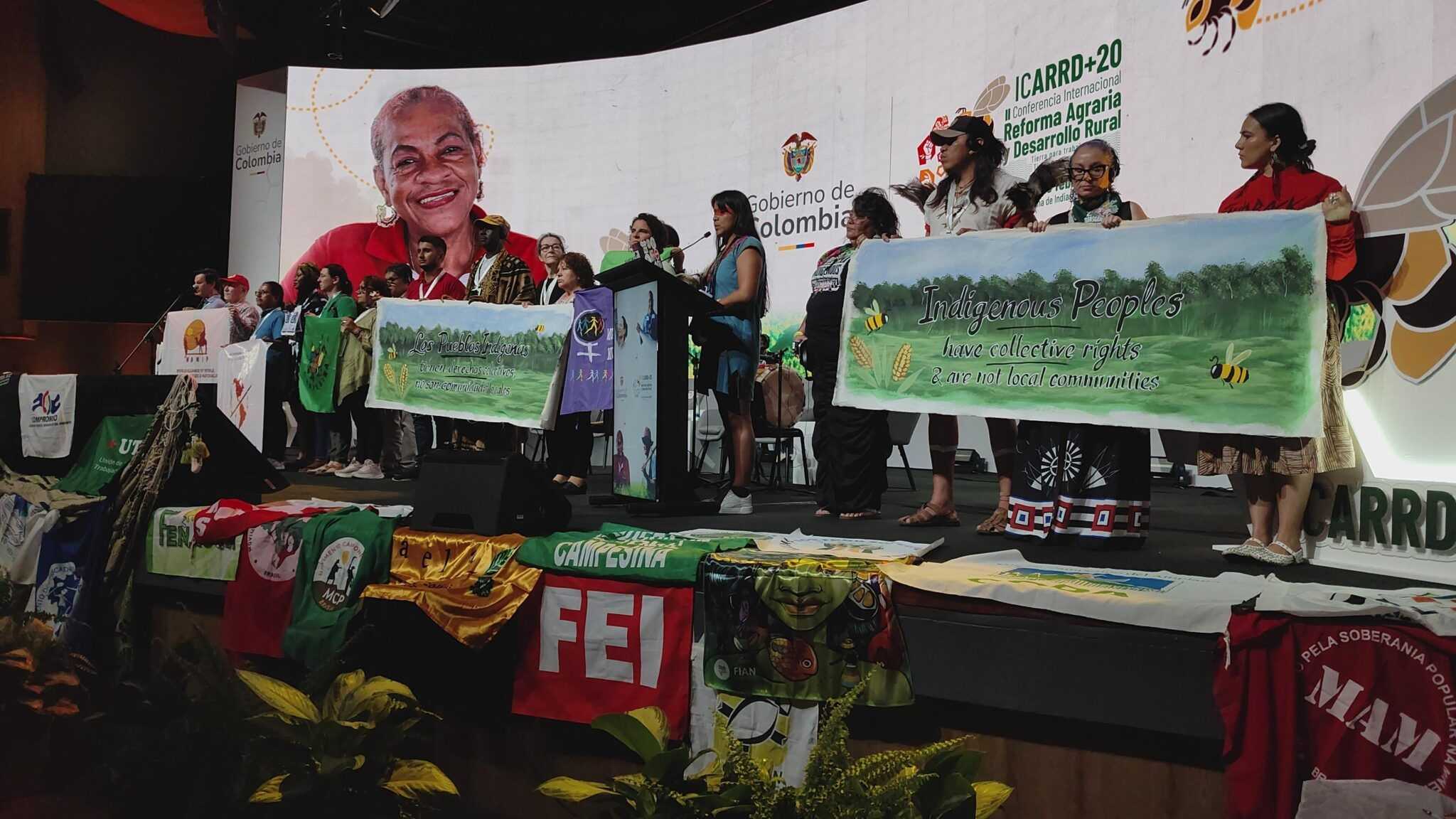
At the closing session of the International Conference on Agrarian Reform and Rural Development (ICARRD+20), Indigenous Peoples and social movements, represented by the International Planning Committee for food sovereignty (IPC)*, issued a strong political statement affirming their “irreducible unity” in the face of ongoing attacks on their rights.
The movements expressed appreciation for the Government of Colombia and Brazil for bringing agrarian reform back into the agenda of the international policy dialogue, and for including their voices in the conference process. They also highlighted the need for Global South governments and peoples to stand united in defense of international law and human rights, noting that Iran is currently facing what they describe as another imperialist attack.
The IPC statement reaffirmed that the rights of Indigenous Peoples and peasants are firmly recognized under international law, including instruments adopted by the United Nations General Assembly such as the UN Declaration on the Rights of Indigenous Peoples (UNDRIP) and the UN Declaration on the Rights of Peasants and Other People Working in Rural Areas (UNDROP). The IPC rejected any attempt to roll back these recognised rights.
A central concern raised was the conflation of Indigenous Peoples with the vague concept of “local communities”, repeated multiple times in the declaration of governments presented to the plenary. While acknowledging the importance of the Conference, the movements stated that they “cannot accept the declaration” adopted at its conclusion. They committed to continued engagement in follow-up processes to ensure that their rights are respected, protected, and guaranteed.
Indigenous Peoples organisations articulating through the IPC under the International Indian Treaty Coouncil (IITC), emphasised that the three UN mechanisms on the rights of Indigenous Peoples have clearly distinguished the unique characteristics, origins, and legal status of Indigenous Peoples’ rights, and warned that grouping them with undefined communities undermines those protections. Similar concerns were expressed for fisher peoples, nomadic pastoralists, peasants, rural workers, and mobile and artisanal communities whose territorial and mobility rights must be explicitly recognized.
The declaration called for a 21st-century agrarian reform that is inclusive of Indigenous Peoples, peasants, fisher peoples, pastoralists, women, youth, gender-diverse people, Afro-descendant communities, family farmers, and rural workers. It stressed that agrarian reform must go beyond land redistribution to encompass forests, oceans, rivers, grazing lands, and migratory routes. Redistribution, Recognition, Restitution and Regulation must form the mutually reinforcing axes of an intergal agrarian reform – speaking to the different realities that exists worldwide. Food sovereignty and agroecology, they affirmed, must be central pillars of this transformation. The strategy and the concrete steps towards a transformative agrarian reform are laid out in the IPC position paper launched ahead of ICARRD+20.
The statement concluded with a call to all governments to engage in good-faith dialogue on Indigenous Peoples’ rights, the rights of fisher peoples and nomadic pastoralists, women’s rights, and agroecology.
“Agrarian reform, food sovereignty, and social, agrarian, and environmental justice will only be achieved through struggle”, the declaration affirmed. “We are going home to organize our peoples and defend the future of our communities and Mother Earth”.
* WHO WE ARE: The International Planning Committee for Food Sovereignty
The International Planning Committee for Food Sovereignty (IPC) is an autonomous and self-organised global platform of small-scale food producers and rural workers organisations and grassroots/community-based social movements whose goal is to advance the Food Sovereignty agenda at the global and regional level.More than 6000 organizations and 300 millions of small-scale food producers self-organise themselves through the IPC, sharing the principles and the 6 pillars of Food Sovereignty as outlined in the Nyeleni 2007 Declaration and synthesis report (Read more).
The IPC facilitates dialogue and debate among actors from civil society, governments and other actors in the field of Food Security and Nutrition, creating a space of discussion autonomous from political parties, institutions, governments and the private sector.
The legitimacy of the IPC is based on the ability to voice the concerns and struggles that a wide variety of civil society organisations and social movements face in their daily practice of advocacy at local, sub-national, regional and global levels.
View the IPC position paper in the three languages
View the LVC briefing note on agrarian reform
Collaborative interview on the conclusions of ICARRD+20 and the Forum of Peoples and Social Movements (Spanish only)