The Peasants’ Rights Observatory: a key tool for the implementation of UNDROP in Latin America
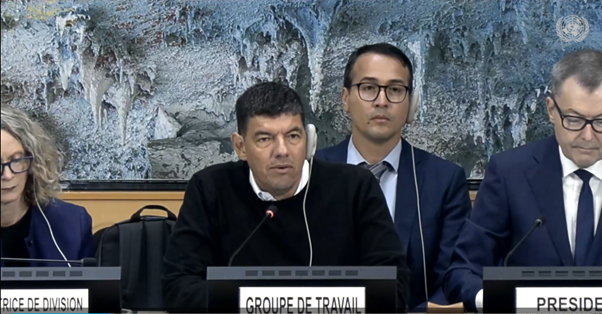
Interview with Diego Monton, National Indigenous Peasant Movement (MNCI)-Somos Tierra of Argentina/CLOC–Via Campesina
In a regional scenario marked by a multidimensional crisis—characterized by the advance of agribusiness, the criminalization of popular struggles, and the weakening of collective rights—peasants continue to be one of the most vulnerable groups and, at the same time, one of the most strategic for food sovereignty, the defense of territories, and social justice. In this context, the effective implementation of the UN Declaration on the Rights of Peasants and Other People Working in Rural Areas (UNDROP) becomes an urgent and deeply political task.
With the aim of strengthening this process, CLOC–Via Campesina has promoted the creation of an Observatory for Peasants’ Rights, an initiative designed as a tool for coordination, monitoring, visibility, and support for rural struggles in Latin America and the Caribbean.
In this interview, Diego Monton, leader and representative of the National Indigenous Peasant Movement (MNCI)-Somos Tierra of Argentina and CLOC–Via Campesina, delves into the objectives, scope, and challenges of this new collective instrument, as well as its potential to support peasant struggles, influence public policy, and strengthen grassroots organization.
What are the main objectives of this new Observatory? How do you hope it will strengthen popular struggles in rural areas and influence public policy on peasant rights in Latin America and the Caribbean?
The Observatory is an initiative intended to serve primarily as a tool for CLOC and La Vía Campesina in Latin America, as well as for other allied organizations. In addition, we want it to be a resource for the UN Working Group of Experts on UNDROP itself, insofar as it makes available relevant information on developments taking place in each of the countries.
The central objective is therefore, on the one hand, to make visible situations in which the rights of peasants are being violated in the countries and in the region, while also emphasizing positive experiences at two levels. First, those related to legislation and public policies based on UNDROP that are progressively turning the rights set out in the Declaration into concrete state actions. Second, by highlighting initiatives led by rural organizations themselves—concrete actions that make it possible to guarantee the rights of peasants.
The Observatory also aims to offer a consultation tool for organizations: a space in which various studies and reports are made available from the perspective of the Declaration itself. We seek to produce information and provide analysis and knowledge that are quickly accessible and that can serve as a basis for the formulation of public policies and legislation. By building links among organizations, the CLOC collective on peasants’ rights, and the UN Group of Experts itself, the Observatory will help provide systematic follow-up on the process of promoting and implementing UNDROP.
In a context of systemic multidimensional crisis, marked by a frontal offensive by the dominant elites who are riding the wave of neo-fascism, the situation in rural areas is increasingly conflictive: how will the Observatory contribute to raising awareness and defending peasants’ rights in the face of predatory agribusiness practices (land grabbing, GMOs, or the criminalization of protests)?
The Observatory must be able to engage in dialogue with peasant struggles and help strengthen them. In fact, in these crisis contexts, the strategy of some states—or of agribusiness financial capital itself—is to stigmatize peasant life and work.
UNDROP makes it possible to legitimize the role of the peasantry, not only by enshrining their rights, but also by recognizing the role they play in promoting food sovereignty, combating climate change, and addressing the phenomenon of migration.
More rights of peasants also mean more rights for workers in all countries, and we aim to contribute—through communication and access to information—to strengthening organizations’ spaces for negotiation. We are convinced that the main tool available to the peasantry in Latin America is mobilization, struggle, and active organization. The Observatory seeks precisely to accompany these processes, while also supporting public institutions that have good intentions and that will be able to find, in addition to specific information, concrete experiences on which to create or develop new initiatives.
In addition, academic circles will be contributing to and drawing from the Observatory. And, as mentioned earlier, the UN Working Group of Experts on UNDROP itself has committed to contributing reports and articles to the Observatory, and to using its outputs to inform advocacy at the international level.
What structure, tools, and methodologies does the Observatory have for monitoring and documentation? And what types of data or indicators will be considered key for its evaluation?
Well, at this initial stage the structure is very simple, with a small staff in terms of the Observatory’s coordination and a few people dedicated to systematization. Work is being carried out in coordination with CLOC, drawing on different experiences of participatory research, and in collaboration with Alianza Biodiversidad, human rights organizations in the region, and other networks.
The aim is for this to be a cooperative, network-based effort that makes it possible to pool resources and to give visibility to many initiatives that are already being carried out and published in different spaces.
There are news agencies covering the situation in rural areas in different countries that are already doing this work, and our goal is to systematize and centralize— in a complementary way— all of this work that is being done in parallel.
We are also working to strengthen the Observatory’s financial capacity, in order to establish our own research group that will allow us to identify the main experiences on which we draw, deepen the level of research, and ultimately develop a solid manual of public policies associated with UNDROP. This should make it possible, whenever there are institutional advances, to quickly obtain ideas and action protocols to move forward with the institutional implementation of UNDROP, as well as to support parliamentary work in all those countries that still need to further develop and adapt their legislation accordingly.
How can rural organizations and their allies — such as the Defending Peasants’ Rights website — collaborate with this new observatory?
There is an email address, [email protected], through which it is possible to get in touch with the Observatory’s coordination team and submit reports, articles, and proposals.
In addition, in Latin America, within the peasants’ rights collective, a network has been gradually built so that country focal points are working to bring the Observatory online. In other words, CLOC’s own organizational structure also functions as a mechanism for this work.
We also hope to build a fruitful collaboration with the website Defending Peasant Rights, so that we can mutually reinforce one another and move forward toward the realization of the fundamental rights of rural peoples.