The Right to Development: A Leverage for Food Sovereignty and the UN Declaration on the Rights of Peasants (UNDROP)
Author: Zainal Arifin Fuat, leader from the Serikat Petani Indonesia (SPI) and member of the International Coordination Committee of La Via Campesina
This article was originally published in the journal Lendemains Solidaires, available in French here.
Food Sovereignty is intended as the right of peoples to healthy and culturally appropriate food, produced through ecologically sound and sustainable methods, and the right of peoples to define their own food and agriculture systems. La Via Campesina insists that diverse, peasant-driven agroecological modes of production, based on centuries of knowledge, experience and accumulated evidence, are central to guaranteeing healthy food to everyone, while ensuring harmony with nature. This paradigm puts the aspirations and needs of those who produce, distribute and consume food at the heart of food systems and policies rather than the demands of markets and transnational corporations. It defends the interests of next generations. It offers a strategy to resist and dismantle the current corporate trade and food regime, building food, farming, pastoral and fisheries systems determined by local producers and users.
Background
The history and background of the concept of Food Sovereignty declared by LVC in 1996 is linked to the failure of the implementation of the concept of food security initiated by the Food and Agriculture Organization (FAO). It was conceived to overcome the challenge of hunger and malnutritinon that was and is particularly – and paradoxically – affecting the rural areas.
During the World Food Summit in 1996, La Via Campesina coined the term, insisting upon the centrality of small-scale food producers, the accumulated wisdom of generations, the autonomy and diversity of rural and urban communities and the solidarity between peoples, as essential components for crafting policies around food and agriculture.
We must remind ourselves that the only way to make our voice heard is by uniting and building new alliances within and across every border. Rural and Urban Social Movements, Trade Unions and civil society actors, progressive governments, academics, scientists and technology enthusiasts must come together to defend this shared vision for the future. Peasant women and other oppressed gender minorities must find equal space in the leadership of our movement at all levels. We must sow the seeds of solidarity in our communities and address all forms of discrimination that keep rural societies divided.
In the commomeration of the 25 years of La Via Campesina, it was declared that Food Sovereignty offers a manifesto for the future of our planet. It is an idea that unites humanity and puts us at the service of Mother Earth that feeds and nourishes us.
"Food Sovereignty offers a manifesto for the future of our planet."
Linking Food Sovereignty to Right to Development
Linking food sovereignty to the framework and concept of the Right to Development (RtD) is very relevant, as the latter must be intended as the right of peasant and rural populations to design and build their own rural development models, autonomously and independently, thus aligning with the perspective and principles of food sovereignty.
The Right to Development is conceived as a process of empowerment that necessarily implies social mobilization and struggle. It becomes a programmatic right that requires structural and specific measures from public authorities in favor of rural workers and communities. Hence the RtD is also a political instrument, a strategic counter-hegemonic legal framework aimed at resisting the dangerous policies imposed by the architecture of globalization, which primarily benefits transnational agribusiness corporations and financial capital, which have always contributed to marginalizing peasantry.
The interrelation between the RtD, food sovereignty and peasants’ rights is further confirmed in the ongoing negotiation of the Draft International Covenant on the Right to Development within the United Nations1. This process aims at legally strenghtening and further consolidating the legal framework of RtD, initially codified through the UN Declaration on the Right to Development (1986).
The Draft Covenant text includes a specific provision recognizing the right of peasants “to determine and develop priorities and strategies to exercise their right to development.” This explicit reference represents both a legal and political advancement. It strengthens the interpretation of the RtD as a right belonging not only to States, but also to organized peoples and communities—particularly rural populations historically excluded from decision-making.
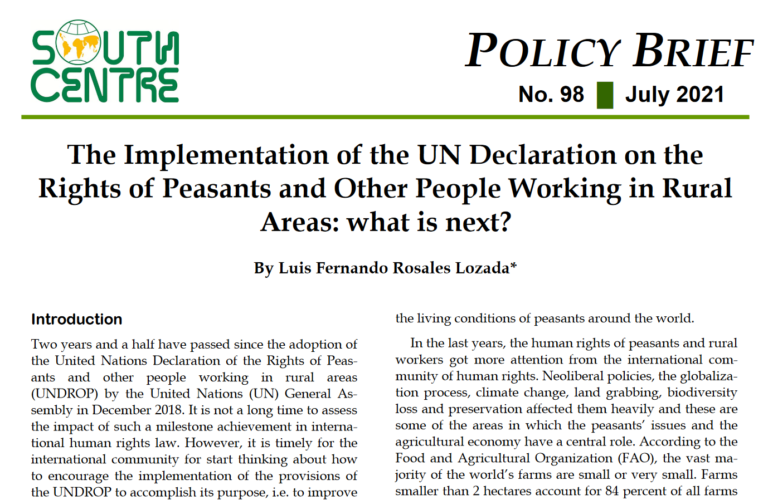
By inserting peasants and rural people as a constitutive element of development, this new legal instrument reinforces the centrality of self-determination in defining agricultural, economic, and territorial priorities. It also consolidates the UN Declaration on the Rights of Peasants and Other People Working in Rural Areas (UNDROP) recognition that peasants must not merely be beneficiaries of policies, but rights-holders capable of designing, implementing, and monitoring their own development models (art. 3 and 10).
What Is Peasant-Led Rural Development?
Our vision of development is cantered on the development of peasant agriculture through agroecology, the only guarantee of dignified and just livelihoods and working conditions for people across the world, especially in rural areas as centre of food production. Therefore LVC proposed and finally success in getting the United Declaration on the rights of peasant and other people in rural areas ( UNDROP) as tool of struggle for Food Sovereignty.
To achieve this, we require public policies that regulate agricultural and food markets, as peasants always do not get the decent income from their food production’s activities for their livelihood and continuing food production ( article 16 of UNDROP). This is because of market mechanism-based food system with corporation control the market .
Among these regulatory mechanisms, we advocate for Minimum Support Prices (MSP), meaning that States must set support prices that cover peasants’ production costs and guarantee a fair income margin. This mechanism reverses the logic of dumping, which depresses prices, thereby protecting peasant dignity.
We also defend public procurement and public reserves. We demand the restoration of public food stock systems to regulate markets and stabilize prices. Public authorities should buy crops during harvest seasons to guarantee floor prices and release them during shortage periods to avoid speculation. Minimim Support Price, Public Procurement and public reserves are for instance implemented in Indonesia and India.
"Public authorities should buy crops during harvest seasons to guarantee floor prices and release them during shortage periods to avoid speculation."
These mechanisms are indispensable because the neoliberal model dismantled these regulatory tools, exposing small producers to competition with large subsidized agribusiness farms. LVC calls for strengthening local and regional supply chains, arguing that trade must prioritize short circuits over transcontinental flows.
Agrarian Reform, the right to land and the RtD
Agrarian reform is linked to access to and control of land and territory, which is now considered a fundamental right, enshrined in international human rights law, particularly through Article 17 of UNDROP. Many phenomenas and corporate initiatives violate and/or threaten the right to land: agrarian conflicts, criminalization, evictions, land grabbing, green grabbing and land concentration driven by agribusiness for large scale of agriculture (monocultures); carbon markets, biofuel and biodiversity offset; mining activities; and “development projects”, as the construction of highways, dams and others. These are the reasons why LVC fights at all levels for comprehensive and people-centered agrarian reform.
This approach goes beyond mere land titling, calling for effective and equitable redistribution of land. It includes setting to clearly limit property size, banning the sale of land to others and foreign entities, and expropriating holdings that rely on illegal or slave labour, especially in large scale agriculture and big plantations.
"This approach goes beyond mere land titling, calling for effective and equitable redistribution of land."
This vision directly opposes market-based “counter-reforms” promoted by the World Bank in the 1990s, which led to land privatization and a new wave of land concentration, imposing a single rural development model, rooted in neoliberalism and favourable to agribusiness interests.
The struggle for rights to land through implementing agrarian reform is therefore part of the RtD, it is a struggle for self-determination and for the right to define one’s own land systems. We advocate for a political understanding of land — as a social and productive ecosystem essential to life — and not as a mere financial asset.
Agroecology, the right to seeds and the RtD
In 2015, during the Second Nyeleni Forum2, delegations representing diverse organizations and international movements of small-scale food producers and consumers gathered to get to a common understanding of agroecology, as a key component of Food Sovereignty.
Agroecology is intended to transform and repair our material reality in food systems, facing a rural world devastated by industrial food production and today by the so-called Green and Blue Revolutions. Agroecology is, thus, also political: it aims at challenging and transforming structures of power in society. It puts the control of seeds, biodiversity, land and territories, waters, knowledge, culture, and all the commons, in the hands of the peoples who feed the world.
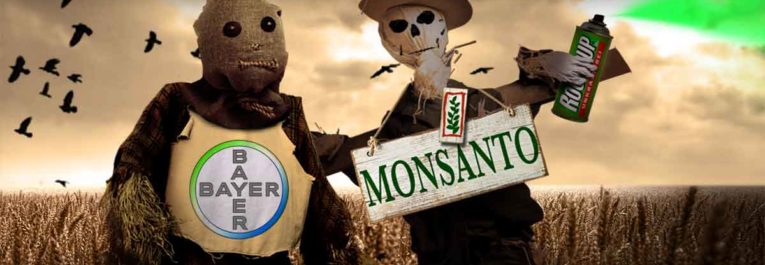
The control of local/native seeds is a key mean of production amid the corporate offensive of seed industries to keep consolidating chemical agriculture. These industries develop genetically modified organismes (GMOs) seeds, while promoting patents (intellectual property rights) at the expenses of local/native seeds. Therefore, LVC strongly rejects the commodification of living organisms, notably through GMOs, patents, and the privatization and commercialization of biodiversity.
In this sense, the movement defends the collective and inalienable right of peasants to save, use, exchange, and sell their seeds, in accordance with Article 9.3 of the International Treaty on Plant Genetic Resources and Article 19 of UNDROP.
Faced with industrial attempts to use synthetic biology and genomics, LVC organizes seed exchanges and campaigns to safeguard traditional community-based systems of biodiversity management. Here again, the struggle for seed rights is rooted in the RtD, in the right of peasants to design and implement their own seed development models based on their traditional and Indigenous practices.
The neoliberal globalization against the rights of peasants
International financial and trade institutions are the main forces behind violations against peasantry and the dismantling of peasant based food systems. The triptych composed of the World Trade Organization (WTO), the International Monetary Fund (IMF) and the World Bank (WB) prevents governments—especially those of the Global South—from implementing essential public policies in favor of rural populations through coercive mechanisms and conditions. These neoliberal actors forced a reduction in the role of the state in the provision of public services, while increasing the role of the private sector (through privatization).
"These neoliberal actors forced a reduction in the role of the state in the provision of public services, while increasing the role of the private sector."
In this regard, it is important to recall that the integration of agriculture into the global free-trade regime through the WTO Agreement on Agriculture (1994) was a devastating turning point. This policy transformed food into a mere commodity and systematically deregulated the agricultural sector, dismantling market regulation tools such as minimum intervention prices and public reserves. The consequences have been systemic: falling agricultural prices, destruction of local peasant markets, loss of autonomy over seeds, and the expulsion of millions of peasants from their territories in favor of large landholders.
The tragic act of South Korean peasant Lee Kyung Hae, who took his life in Cancún in 2003 while wearing a banner that stated “WTO Kills Farmers,” remains emblematic of the violence of this neoliberal and neocolonial-imperialist system.
However, the neoliberal trade regime is not only the WTO, but it is also characterized by the spread of free trade and investment agreements at both regional, mulitilateral and bilateral level. In addition, today we are also facing Trump’s trade policies, which force countries to open market fully, but not vice-versa.
The Struggle for an Alternative Trade Framework
In response to the damage caused by the WTO Agreement on Agriculture, LVC launched a process to urgently claim for the creation of a new international trade framework grounded in food sovereignty. This new framework must be based on solidarity, international cooperation, and social justice. Its main purpose is to redefine the function of trade—from a tool that maximizes the profits of large transnational corporations to one that guarantees human rights and food sovereignty.
By asserting that agricultural and food trade must comply with human rights—and that the right to food is a fundamental human right, not a commodity—LVC advocates for a new trade framework that protects peasants’ rights and legitimizes States’ measures such as market protections against dumping and guaranteed support prices for producers.
"La Via Campesina advocates for a new trade framework that protects peasants’ rights and legitimizes States’ measures such as market protections against dumping and guaranteed support prices for producers."
To this end, LVC identifies the United Nations Conference on Trade and Development (UNCTAD) as the legitimate forum to build this renewed multilateral consensus, considering it a counterweight capable of realigning global trade norms with human rights.
Conclusion
Development, as conceptualized by La Vía Campesina, is an integrated and radical response to the systemic failures of the neoliberal model. It is defined by the achievement of dignity, social justice, and ecological sustainability for rural populations.
We will continue to fight for our rights by all means at our disposal, but above all through the popular mobilization of our masses. We will continue to consolidate advocacy through international legal instruments, such as UNDROP, to demand the implementation of redistributive and regulatory public policies that can realize our right to development, namely our right to define our own rural and agricultural development systems and models, in light of the food sovereignty paradigm.
By emphasizing autonomy and peasant knowledge, and by placing rural women and youth at the center of struggle, LVC proposes a pathway that prioritizes the protection of ecosystems and communities over capital accumulation, reaffirming its commitment to systemic transformation of the global economic, trade, financial, and social order.