Without land, without seeds, there is no future for farmers
Article originally published in Spanish by Elena Rusca on June 25, 2026, in the Chilean newspaper El Clarín. Available here.
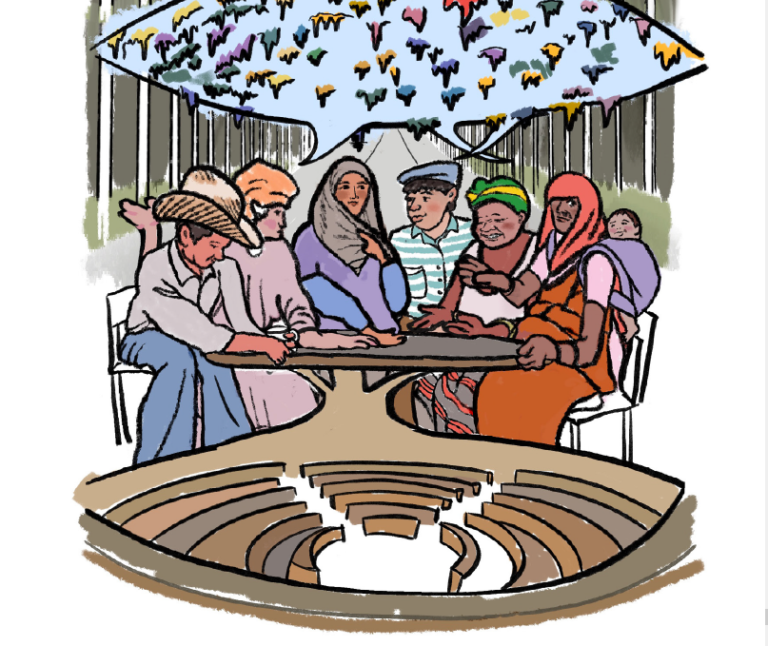
*Image: El mundo campesino. Elena Rusca
By Elena Rusca, June 25th, 2026
Interview with Geneviève Savigny, a member of the UN Working Group on the Rights of Peasants (UNDROP)
Geneva, June 25th, 2026 — Elena Rusca
As food, climate, and geopolitical crises intensify, small-scale farmers—who feed the majority of humanity—remain among those most vulnerable to poverty, dispossession, and violence. Since 2018, the United Nations Declaration on the Rights of Peasants (UNDROP) has provided an unprecedented framework for protecting their collective rights, their seeds, their lands, and their knowledge. But its implementation remains fragile. Geneviève Savigny, a member of the Working Group on the UNDROP, analyzes the agricultural, seed-related, and political challenges facing the world’s rural areas today—from West Africa to Latin America.
UNDROP: A Historic Text Born of Peasants’ Struggles
Adopted in 2018 by the United Nations General Assembly, the Declaration on the Rights of Peasants and Other People Working in Rural Areas is one of the most ambitious instruments of the international system. The result of nearly twenty years of mobilization led by La Vía Campesina, it seeks to protect those who produce most of the world’s food but who remain the most vulnerable to poverty, expropriation, violence, and political marginalization.
UNDROP recognizes rights that are rarely explicitly stated in other international texts:
- the right to land,
- the right to seeds,
- the right to water,
- protection against evictions,
- participation in decision-making,
- collective and customary rights,
- and the recognition of peasant knowledge.
To ensure its implementation, the Human Rights Council established a Working Group in 2023 composed of five independent experts. Geneviève Savigny, a farmer and former member of the Peasants’ Confederation and La Vía Campesina, is a member of the group.
An international working group to defend the rights of peasants
— How was your working group formed?
G. Savigny: “The working group was formed by the Human Rights Council after a resolution was adopted in the fall of 2023. We were selected during the winter, and there are five of us. Personally, I am a farmer and a former member of the Peasants’ Confederation and La Vía Campesina. The others are Carlos, an anthropologist and professor in Colombia; David, a law professor in Armenia; Shalmalee, former director of the NGO Focus on Global South; and Uche, a Nigerian law professor working in the United States.”
— How do you work, specifically?
G. Savigny: “Our group holds two annual five-day in-person sessions, usually one in Geneva and another in New York. This year, we decided to replace the second session with country visits. We just completed a visit to Ghana, and another is scheduled for November in Paraguay. Each time, two members of the group go, along with our staff.”
— What do you do during these visits?
G. Savigny: “We meet with representatives from various ministries related to agriculture and food, and then with representatives of farmers, fishermen, herders, and rural women. In Ghana, the meetings had to be arranged through the government or local authorities so we could meet with village chiefs. The goal is to understand how farmers’ rights are being implemented, what the strengths are, and what can be improved. We then draft a report that will be presented in the fall.”
Participation: An Essential Right, Yet Difficult to Exercise
— You published a report on the right to participation. What were your conclusions?
G. Savigny: “Participation is truly indispensable for ensuring that the situation of rural men and women is taken into account and addressed appropriately. But there is still much to be done, including for practical reasons: translation, distance, and the difficulties of traveling to centers of power.
As for women, there is a particular challenge in freeing themselves from domestic chores and daily work in order to participate in decisions that affect them. This adds an extra layer of difficulty in a rural world where work is very demanding and often isolating.”
Seeds: A Crucial Challenge in the Face of Multinationals
— This year you are working on the right to seeds. Why is this so important?
G. Savigny: “Article 19 of the UNDROP specifies that farmers must have the right to maintain farmer-based seed systems: to save, reproduce, exchange, and sell seeds. The state must also support the existence of this system. This is not always the case, as there is a very dynamic, even aggressive commercial system in place, depending on how you look at it.”
— Do GMOs play a role in this issue?
G. Savigny: “Yes, of course. With technological advances, we now have much easier and faster ways to create GMOs. To facilitate their distribution and commercialization, seed companies no longer want them to be called GMOs, but rather NGT—New Genomic Techniques. They want it to be recognized that these traits could occur naturally, so there would be no need to label them.
But there are patents filed on them! And there is a fear that patented traits—which are not labeled—might appear naturally in farmers’ plants that they have been selecting for years.”
— What does this mean for farmers?
G. Savigny: “The patent on the CRISPR-Cas system, for example, belongs to a single company. There is an ever-increasing concentration of rights that determine whether or not seeds can be multiplied. In response to this, many seed laws impose strict rules for the certification and commercialization of seeds, which contradicts farmers’ right to seeds.
Farmers must assert this right, and governments must realize that—even for the sake of biodiversity and plant resilience—the small-scale breeding carried out by local farmers must not be halted. There is an entire system that must be preserved if we want to maintain significant biodiversity and crop diversity.”
Land and Territory: Collective Rights Yet to Be Recognized
— They are also working on the issue of land. What is the main challenge?
G. Savigny: “We’re working on Article 17 of the declaration, which addresses the rights to land and territory. Interestingly, UNDROP highlights the importance of collective and customary rights. This is important because that’s where the problem lies in many places: since there are no clear property titles, the situation becomes informal.”
— And in Switzerland, how do you view access to land?
G. Savigny: “I believe the right to land serves to illuminate new paths. Secure access to land is needed, not necessarily ownership. I hope that in Switzerland we can develop leasing arrangements or forms of collective ownership that provide security for those who cultivate the land.
There’s a major problem: an entire generation is reaching the end of their working lives with meager pensions and few resources. Sometimes they don’t want to pass the land on to younger people. It’s a widespread social problem. If we want high-quality food production, we must also solve the problem of access to land.
Buying land is prohibitively expensive. And we have to be careful because in some countries, even in Europe, it’s corporations that are buying up the land.”
Latin America: A “Peasantization” Under Attack but Essential
— For our Chilean readers, what is your perspective on “peasantization” in Latin America?
G. Savigny: “In Latin America, I believe ‘peasantization’ is essential. Together with indigenous peoples, they form the core of an agricultural sector that is, at the same time, under intense attack from the rise of highly intensive industrial agriculture.
This is reinforced by free trade agreements aimed at increasing exports of products and raw materials. What the farmers there say is that this does not serve to protect them.
It’s a region I don’t know perfectly well, but it seems so rich and diverse. From a cultural standpoint, it is rural and indigenous. In Latin America, artisanal production methods remain very important. Food quality also comes from being able to eat fresh vegetables everywhere.”
— Is it also a struggle against transnational corporations?
G. Savigny: “Of course. Small farmers must be supported; transnational corporations must be held in check, because they have a natural tendency—I think it’s even their business model—to expand, consolidate, and maximize profits. But there must be limits, because otherwise, it’s destructive both environmentally and socially.”
The UN’s “special procedures”: explaining the mandate
— Can you explain what the special procedures are?
G. Savigny: “Working groups are part of the special procedures, as are special rapporteurs. They focus on a particular aspect of human rights, such as the right to food or the right to water. We are a working group: instead of a single special rapporteur, there are five of us, which reflects the diversity and breadth of the issue.
Our role is to implement the Declaration on the Rights of Peasants and Other People Working in Rural Areas, the UNDROP. It is a text adopted in 2018 by the UN General Assembly that comprises twenty-eight articles summarizing the rights necessary for peasant activities.
It defines what constitutes a peasant, the obligations of States, non-discrimination, women’s rights, the right to resources, the right to participation, to information, to education, and so on—all detailed in a manner tailored to the rural context.”
The Working Group will present its reports on land and seeds this coming September in Geneva. These documents, which will be submitted to the UN General Assembly, should shed crucial light on the issue.