Food Sovereignty as a Lever to End Corporate Impunity: A powerful Side Event at the UN featuring social movements and UNDROP rights holders.
Global food systems stand today at the epicenter of a profound confrontation between two irreconcilable paradigms: an extractivist, agro-industrial model driven by transnational capital, and the struggle of peoples and rural communities for food sovereignty, environmental justice, and the right to health. During the twelfth session of the United Nations negotiations toward a legally binding instrument on transnational corporations and human rights in October 2026, frontline human rights defenders and social movements from the Global Campaign to Reclaim Peoples’ Sovereignty, Dismantle Corporate Power and Stop Impunity brought the lived experiences of peasants, rural women, and artisanal fishers directly into the multilateral arena. From the deregulation of genetically modified seeds in Europe and the criminalization of indigenous and peasant seeds in Southern Africa, to generational land grabbing in Uganda, coastal destruction in Sri Lanka, and the global cycle of agro-toxic and pharmaceutical dependency, the testimonies gathered in this report expose the systemic nature of corporate impunity. By bridging grassroots territorial struggles with international human rights law, this panel underscored a clear political imperative: achieving food sovereignty and protecting the commons require holding transnational corporations legally accountable under a strong and enforceable international treaty.
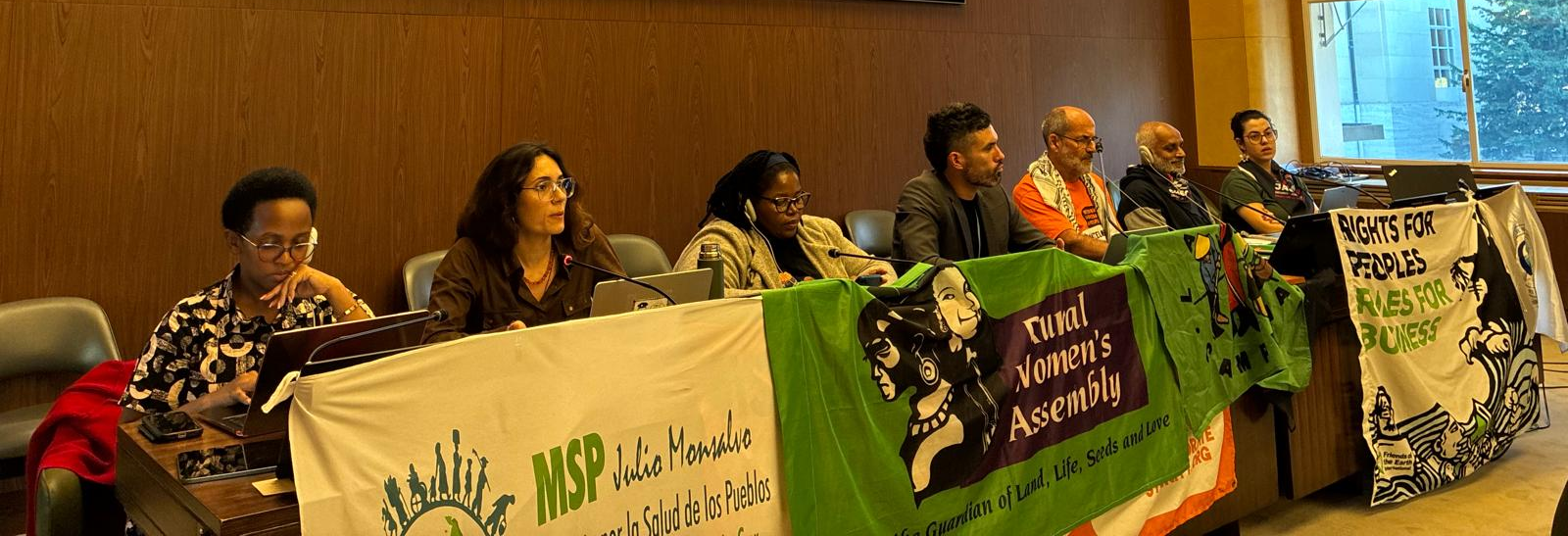
The side event entitled “Food Sovereignty as a Lever to End Corporate Impunity: Rural Women, Peasants, and Fishers’ Voices for Just and Resilient Food Systems” took place on Wednesday, 14 October 2026 at the United Nations, on the sidelines of the twelfth session of the open-ended intergovernmental working group (OEIGWG) on transnational corporations and human rights. The event, which brought together an international coalition of social movements, made visible the brutal impacts of transnational corporate power on rural communities. The movements reclaimed peoples’ right to food sovereignty and demanded the elaboration of an effective legally binding instrument to put an end to the impunity of transnational corporations.
This event built on corporate control over global food systems, which constitutes one of the most severe threats to human rights, ecosystems, and community survival. Far from feeding the planet, transnational corporations impose an agro-industrial and extractivist model driven by financial speculation and profit maximization. This system relies on monocultures, industrial aquaculture, pollution, genetically modified organisms, agrochemicals, and concentrated animal feeding operations dependent on the massive use of antibiotics and antivirals. At the same time, free trade and investment agreements reinforce this architecture by putting peasants and artisanal fishers in direct competition with agribusiness giants, while allowing foreign investors to sue States before arbitration tribunals whenever they adopt regulations aimed at protecting their land, waters, or public health. In direct opposition to this regime of dispossession, the food sovereignty model, articulated and defended through the International Forum for Food Sovereignty of Nyéléni, prioritizes local and national markets, empowers peasant and fisher communities, and recognizes the central role of rural women in food production, processing, distribution, and management.
The first intervention of the panel was delivered by Pierre Maison, representative of the Confédération paysanne and the international movement La Via Campesina in France. He revisited the genesis and strict definition of food sovereignty in order to denounce its political co-optation: “The concept of food sovereignty, which was developed by La Via Campesina beginning in 1996 in response to the concept of food security, is the right of peoples, peasants, communities, and countries to define their own agricultural models, fisheries, and food policies (for example, what is grown, how it is grown, and for whom) and, above all, to respect the food sovereignty of other countries (that is, without dumping)”. He illustrated this semantic distortion with the example of France, which has a Ministry of Agriculture and Food Sovereignty that nevertheless encourages production for export without concern for the consequences on third-country markets, even though “food sovereignty, on the contrary, seeks to replace competition with solidarity”.
Pierre Maison then outlined the regulatory rollback observed within the European Union. While the Green Deal and its “Farm to Fork” strategy set ambitious targets for halving pesticide use and reaching 25% of agricultural land under organic farming, the influence of seed and agrochemical lobbies has caused a complete reversal. Two recently adopted regulations on seeds deregulate new genetic techniques (NGTs), which are assimilated to new GMOs. The majority of these seeds will be allowed to be grown without prior risk assessment and without consumer labeling, entailing a major risk of dispersal and contamination of peasant seeds, while the legal space allowing the exchange of peasant seeds is shrinking considerably. Furthermore, a so-called “Omnibus” law is in the process of being adopted at the European level regarding the evaluation of pesticides. Under the guise of administrative simplification, this text considerably weakens controls: “Until now, authorization to use a pesticide has been granted for three years before reevaluation. However, this law calls for such authorization to be granted indefinitely. It also calls for extending the period during which a pesticide can be sold after it has been banned. It has also been shown that certain parts of this law are direct copy-and-paste excerpts from an agribusiness-friendly agricultural organization”.
Faced with this legislative offensive, mobilizations coordinated by La Via Campesina took place on 3 October in several European countries, notably bringing together 15,000 people near a Syngenta factory south of Paris, where peasants, environmental associations, and victims of pesticide-related cancers converged. During these rallies, the practice of “green colonialism” was strongly condemned, a term referring to the fact that “pesticides banned for use in the European Union are still produced within the EU for export”. Pierre Maison concluded his remarks by recalling that the influence of transnational corporations systematically violates several provisions of UNDROP (notably the rights to seeds, biological diversity, health, clean drinking water, and a healthy environment), hence the imperative to adopt a strong binding treaty, as the Declaration itself does not have binding enforceable power.
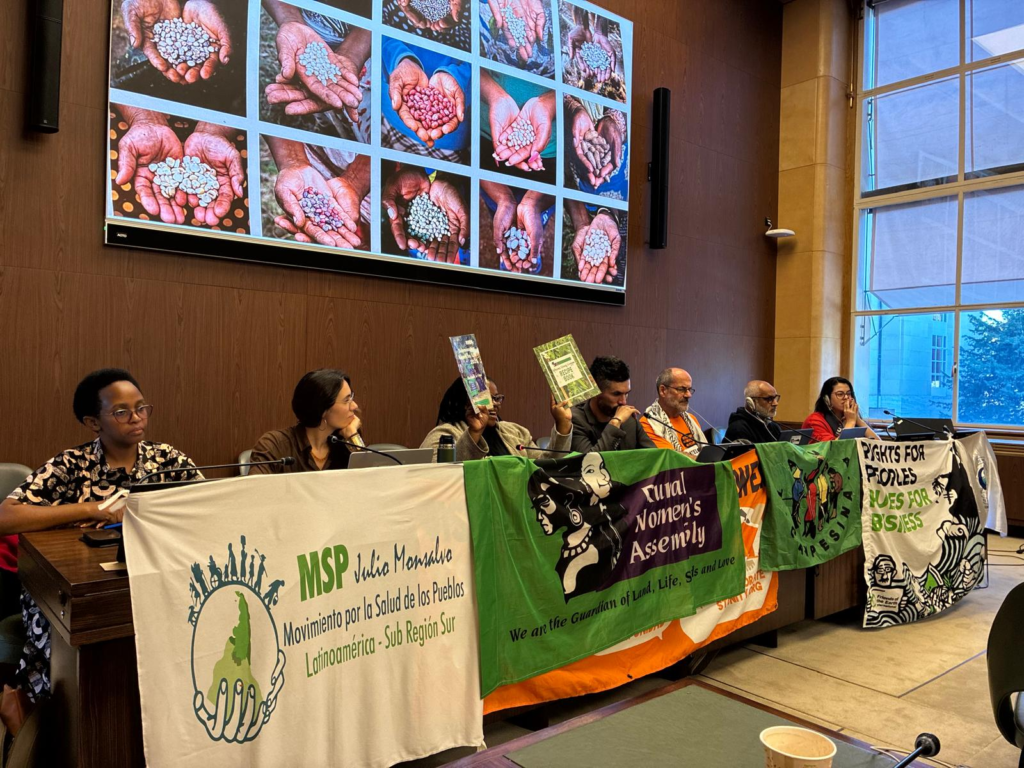
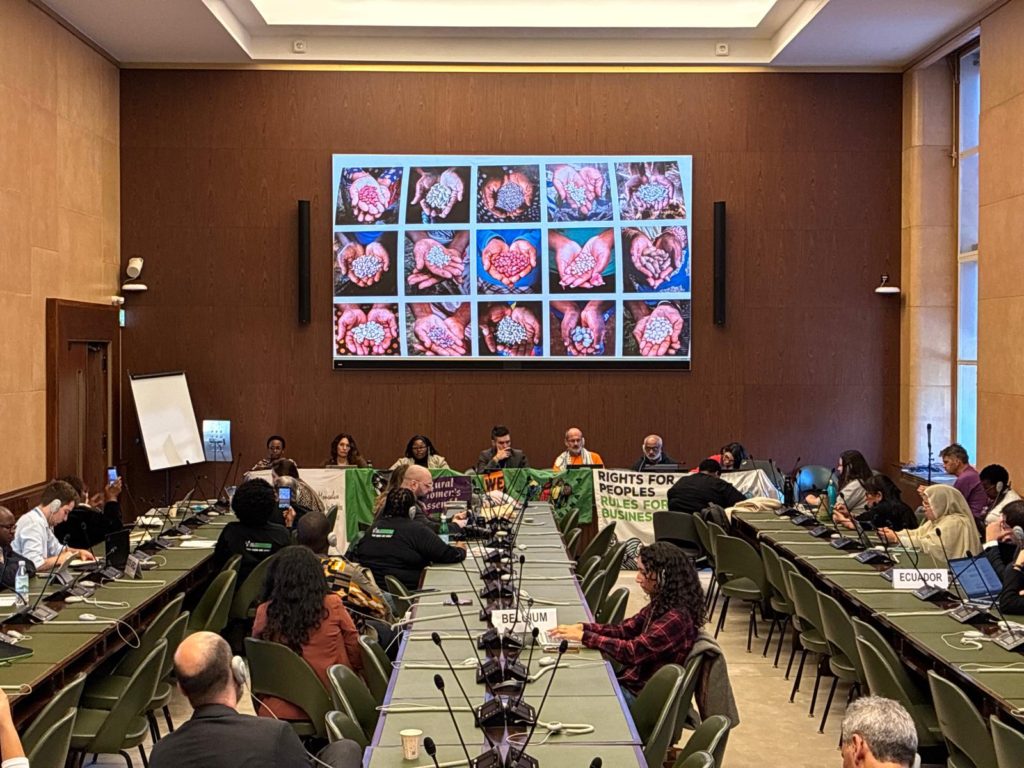
Following up on this analysis of seeds and land, Zakithi Sibandze, representative of the Rural Women Assembly (RWA) – Swaziland, brought a Southern African perspective on the consequences of international cooperation and corporate capture on food sovereignty. She structured her intervention around three main threats weighing on local food systems. First, she denounced the criminalization of indigenous seeds through legal frameworks inspired by the International Union for the Protection of New Varieties of Plants (UPOV), whose promotion at the African Union level has recently been supported by funding from Bayer and the World Bank. Second, she highlighted the proliferation of toxins from chemical fertilizers, pesticides, and the extractive industry, citing in particular the case of the Maloma mine, which pollute water resources and hinder communities’ efforts to practice agroecology. Third, she challenged contract farming and land grabbing. Zakithi Sibandze highlighted the organic link between land and plant genetic heritage: “Without land there is no food sovereignty; equally, without resilient indigenous seeds there cannot be resilient food systems”. Reaffirming that African food is intrinsically resilient, she demanded that the future Binding Treaty assign legal liability to transnational corporations throughout their global value chains, guarantee comprehensive remediation for affected communities, and enshrine the unqualified primacy of human rights over trade rules: “We call for a Binding Treaty that protects the people who feed the planet, not the corporations that poison it”.
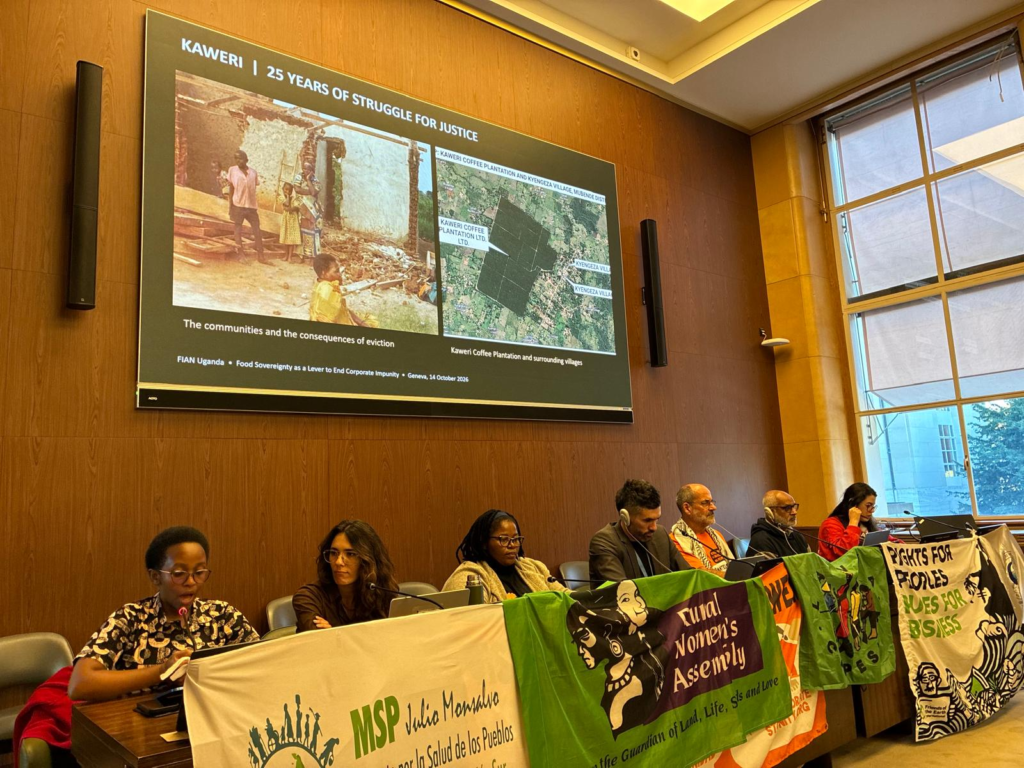
The concrete and generational reality of land grabbing was then further presented by Rehema Bavuma, representative of FIAN Uganda, through a detailed case study on the experience of the Kaweri community, whose struggle for justice has lasted for twenty-five years. Although coffee is a major export commodity for Uganda, the Kaweri case illustrates the abuses that occur when investment takes precedence over fundamental rights. In August 2001, approximately 4,000 people from four villages in Mubende District, in central Uganda, were forcibly evicted by Ugandan security forces to make way for the Kaweri coffee plantation, operated by a subsidiary of the German group Neumann Kaffee Gruppe. Some community members were forced, under threat of force, to sign documents written in English that they did not understand. During this brutal eviction, homes were demolished, crops destroyed, and farming families lost all access to their food-producing lands, where their graveyards, churches, mosques, and cultural institutions were also located. Even the community’s primary school was taken over to serve as the plantation’s headquarters.
Addressing the very notion of free, prior and informed consent, Rehema Bavuma posed a fundamental question to the assembly: “Can we really speak of consent when communities have no genuine opportunity to understand, question or refuse decisions affecting their land?”. Today, this plantation covers approximately 2,500 hectares and annually produces between 1,600 and 3,000 tonnes of coffee for commercial markets, generating continuous profits for a quarter of a century while the dispossessed families struggle for survival. Legal proceedings, initiated as early as 2002 by the communities, have been marked by countless appeals and procedural delays. It was only in January 2025 that a compensation process began for 258 families who accepted the government’s offer, while 143 other families are still pursuing their claims before the courts.
The human toll of this judicial slowness is particularly heavy, as 81 family representatives died before being able to obtain justice. As the Rehema emphasized: “The harm caused by dispossession can happen in a matter of days, but obtaining justice can take an entire generation”. The Kaweri case, which involves a company operating in Uganda but whose parent company is domiciled in Germany, blatantly demonstrates the obstacles victims face when seeking to hold economic actors accountable across borders and complex corporate structures. For FIAN, the adoption of a Binding Treaty is indispensable to prevent such violations, guarantee effective community participation, and grant populations the right to challenge harmful investments before the damage becomes irreversible. Rehema Bavuma concluded her intervention by recalling the very essence of this paradigm: “Because food sovereignty is not simply about producing food. It is about protecting people’s rights to land, livelihoods and a meaningful say in the decisions affecting their lives”.
Broadening the issue to aquatic and marine ecosystems, Herman Kumara, from the National Fisheries Solidarity Movement in Sri Lanka and Secretary General of the World Forum of Fisher Peoples (WFFP), took the floor to denounce the impacts of industrial aquaculture. He expressed WFFP’s deep concerns over the “Blue Transformation” programme promoted by the Committee on Fisheries (COFI) of the Food and Agriculture Organization of the United Nations (FAO), which guides the future of fish production while neglecting the rights and crucial importance of artisanal fishing communities. The expansion of transnational corporations in the aquaculture sector takes place in disregard of national laws and leads to systematic human rights violations, pollution of water bodies, coastal land grabbing, and the destruction of mangrove ecosystems.
Herman Kumara recalled that the Nyéléni global food sovereignty movement has made the global campaign against industrial aquaculture one of its six priority strategic axes. The logic of food sovereignty of fishing communities (which conceives food as a way of life, a livelihood, and a cultural heritage) is diametrically opposed to that of transnational corporations, “who see our food, water and territories as commodities and resources to be exploited for profit-making”.
Finally, the cross-cutting dimension of public health within territorial struggles was then developed by Candelaria Araoz Falcon, representative of the People’s Health Movement (PHM), followed by the presence on the panel of Letícia Paranhos, from Friends of the Earth International (FoEI). Candelaria Araoz Falcon stated from the outset that food sovereignty is inseparable from the right to health, which is not defined solely by biological factors, but is socially and politically determined by power relations and control over the commons: “We start from a clear premise: there are no healthy bodies in sick and plundered territories”.
She delivered a structural analysis of what she calls “the profit cycle”, a transnational extractivist mechanism articulated in two distinct phases. In the first phase, the agro-industrial model makes populations sick: through monocultures, agrotoxins, transgenic organisms, intensive livestock farming, and antibiotic-dependent industrial aquaculture, it poisons the air, soil, water, and food. This process causes cancers, birth defects, endocrine disruptions, respiratory disorders, and accelerates antimicrobial resistance, considered one of the greatest threats to global public health. Simultaneously, the food industry floods markets with ultra-processed products designed for profit rather than nutrition, fueling a global pandemic of chronic non-communicable diseases. In the second phase, the pharmaceutical industry (Big Pharma) steps in: “While agribusiness and the food industry make us sick, Big Pharma profits by managing the symptoms through perpetual medical and pharmacological dependence. The very same corporate structure that makes you sick is the one that then sells you the medications”.
For the People’s Health Movement and the Nyéléni movement, these two sectors treat food and health as mere financial assets aimed at capital accumulation. This model affects all territories: it destroys the direct sources of nutrition of fishing communities, plunges farming families exposed to pesticides into debt and impoverishment due to the privatization of healthcare, and disproportionately hits rural women. The latter suffer direct exposure to toxic substances in a context of precarity, invisibility, and a total lack of social protection or sick leave, while assuming, through grueling unpaid labor, the burden of caring for children, the sick, and the elderly.
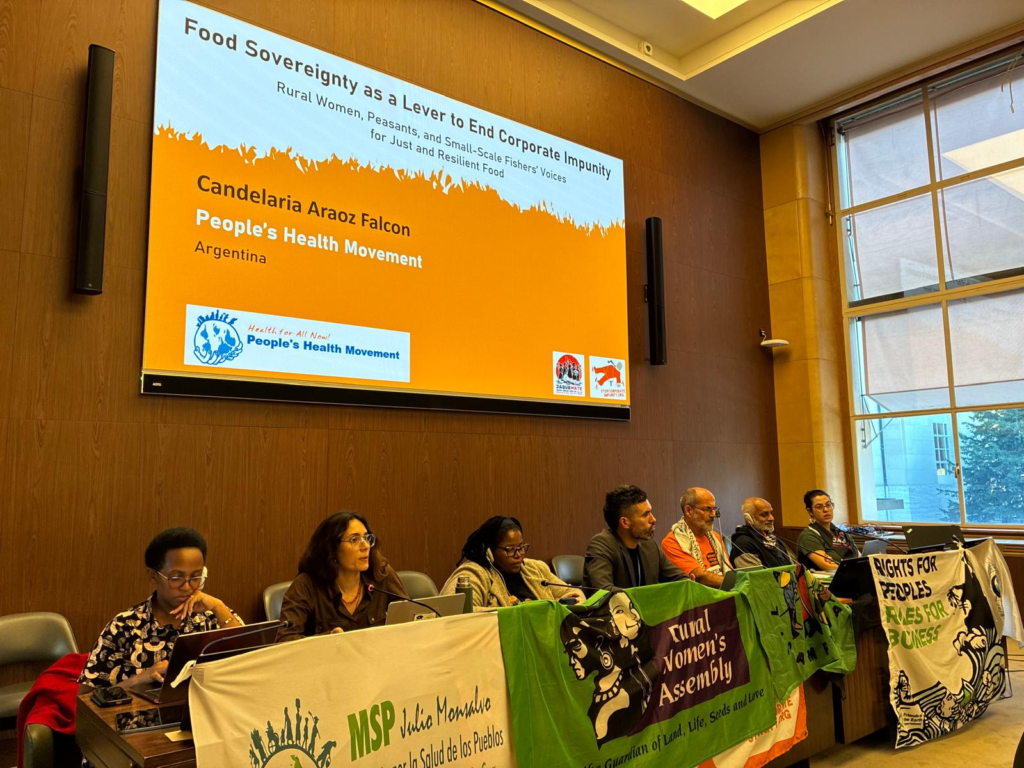
Candelaria Araoz Falcon concluded by denouncing the corporate capture of global governance spaces, observing how certain multilateral agencies promote false technological solutions, such as fortified foods or large-scale aquaculture, which serve the financial interests of agribusiness and pharmaceutical firms to the detriment of agroecology, traditional diets, and local economies. Faced with this observation, she issued a solemn appeal to the state delegations participating in the UN negotiations: “Food sovereignty and the right to health cannot be realized under the cloak of corporate impunity: the lives of communities and the protection of our common goods must take precedence over the profits of transnational capital. That is why we urge States to support the Global Campaign’s proposed text for a strong and effective Binding treaty. We issue an urgent call, especially to the States of the Global South: do not yield to corporate pressure or accept weak voluntary standards”.
Bringing these interventions to a close, Letícia Paranhos, from Friends of the Earth International (FoEI), situated transnational corporations at the center of an architecture of impunity that obstructs climate and social justice. She emphasized that capitalism, racism, patriarchy, imperialism, and the exploitation of the working class form a single system that must be fought in an integrated way, recalling that there is no agroecology without feminist and anti-racist struggles, nor environmental justice as long as apartheid and genocide continue in Palestine. Strongly condemning market-based false solutions—such as carbon markets, offsets, and agromining—as instruments of green colonialism, she emphasized that those defending agroecology and food sovereignty and those demanding binding rules on transnational corporations stand together on the exact same front: “I believe that our role as a campaign is to ensure cross-politicisation between our struggles, to denounce voluntary frameworks as a false solution that only continues to guarantee the status quo of this system”.